
Are opals bad luck? It’s a persistent rumor, one that I’ve heard and seen many times. Let’s take a look at where this idea comes from and see if it’s worth heeding or not.
Are opals bad luck? Let’s trace the myth.
I was in high school the first time that I heard that opals are bad luck. A friend pulled me aside and said that a mutual acquaintance’s new opal jewelry was pretty, but wasn’t it a shame that she would now have bad luck?
I was shocked. This ethereal, iridescent, alluringly color-changing stone was unlucky? How could that be true for something that looked so magical?
Since then, I’ve head many versions of the opals are bad luck myth: that they’re only bad luck if you buy them for yourself, that they’re bad luck to give as a gift, that they’re only bad luck to wear if you weren’t born in October (because if opal is your birthstone, it negates the bad luck).
Today we’re going to answer the question “Are opals bad luck?” by taking a look at the historical associations of opals and see where this bad luck association came from, while also enjoying 15 years worth of photos of opal jewels I have encountered in my career.

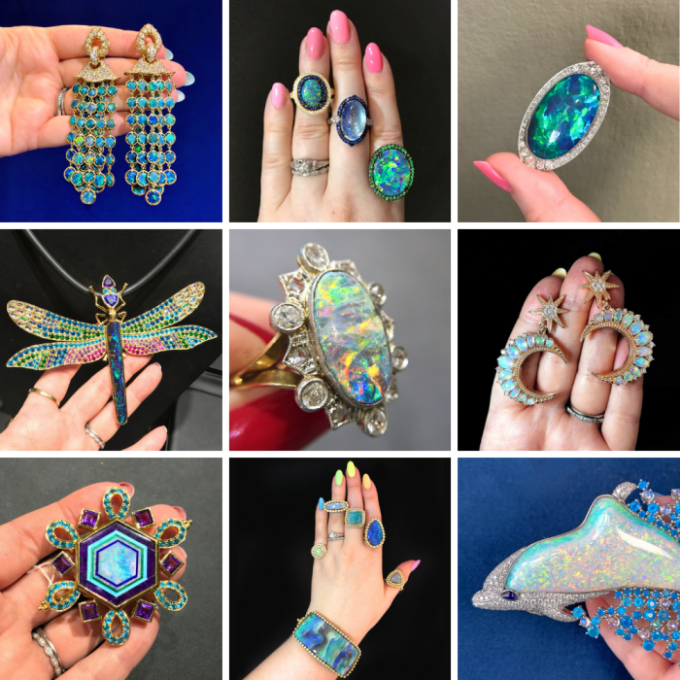
Opal, diamond, and emerald ring by Arunashi. Opal earrings by Marina B! In gold, with diamonds The most delightful Lydia Courteille ring, with a huge, glorious opal Antique opal and diamond necklace seen at the Miami Beach Antique Show in 2016. Antique opal ring from Jewels by Grace with rubies and diamonds. Alessio Boschi earrings with opals, gemstones, and diamonds. 
Jimmy NG ‘Flipper’ dolphin brooch with 99.96 carat opal with diamonds, apatite, and moonstones. Opal necklace with huge Ethiopian opals, carved emerald beads, onyx, and diamonds. Seen at John T Haynes. A harlequin opal and diamond ring by V Tse Jewelry. Opal and diamond earrings by Baiyang Qui, seen at the American Craft Council Show. A tanzanite and opal flower ring by V Tse Jewelry. Opal statement earrings by Heather Guidero Jewelry. Antique opal bracelet by Marcus & Co with garnet and sapphires. Seen at Lauren DeYoung during NYCJAOS Spring 2026. Rose gold and opal crescent moon earrings by Dallas Prince Designs. Opal and gemstone pendant by Jacquie Aiche. Dragonfly brooch pendant by Paula Crevoshay, with opal body and gemstone wings. Opal earrings by Omi Prive. Paula Crevoshay intarsia brooch with opal, amethyst, and more gems. Opal rings at the AGTA Spectrum Awards 2023. By Omi Prive, Pompos, Nicole Mera, and Erica Courtney. Edwardian era black opal ring from Under the Crown jewelry. Victorian era opal and lapis pendant from Reverie, seen at NYCJAOS Spring 2025.
Ancient associations
Humans have revered opals for most of recorded history. The ancient Greeks believed that opals could lend their owners the gift of prophecy and guarded them from disease. To the ancient Romans, opals symbolized love and hope. Ancient Arabic legends said that opals fell from the heavens in flashes of lightning.
The Romans believed that because opals carried the colors of all other stones, they also contained the virtues of all other stones. Pliny the Elder wrote of opals in his Naturalis Historia: “For in them you shall see the living fire of the ruby, the glorious purple of the amethyst, the sea-green of the emerald, all glittering together in an incredible mixture of light.”
Because of its changeable appearance, opals were frequently associated with magic. One legend even said that carrying an opal wrapped in a bay leaf would keep people from noticing the carrier, making them functionally invisible.
In the Middle Ages, opal was called ophthalmios, or the eye stone, because of the widespread belief that the stone could cure any eye disease.
Tiara by French jewelry designer Lydia Courteille with opal and colored gems. Two Omi Prive opal rings and one moonstone ring. Hilary Finck Jewelry gold and opal earrings. Antique opal and diamond ring from Prather Beeland; brooch conversion. Mexican opal necklaces by Amali Jewelry. Opal ring by Somewhere in the Rainbow with 19.64 TCW opal with diamonds (2.80 TCW). Dragon and fairy opal pendant, handmade by Hunt Country Jewelers in gold. Opal, diamond, and gemstone ring by Arunashi. Two carved opal pendants by Amali Jewelry. I love this rose gold and opal crescent moon necklace by Dallas Prince Designs. Mexican fire opal ring with enamel and diamonds, by Yael Designs. Gemstone and opal rings by Vazanaa Studio. Extraordinary antique opal bracelet by Marcus & Co with garnet and sapphires. Seen at Lauren DeYoung during NYCJAOS Spring 2026. Articulated opal, sapphire, and diamond insect brooch, from J. Elizabeth Estate Jewelry. Wwake opal rings. Paula Crevoshay brooch with sphene, opal, blue zircon, sapphires, tsavorite, and apatite. Antique opal ring from DK Bressler. Black opal ring with blue and yellow Diamonds and opal necklace with Paraiba Tourmaline, Alexandrite, and Spinel. By Llyn Strong. Black opal ring with 15.22 ct opal, Paraiba tourmaline, tsavorite garnet, and diamonds. By Omi Prive. Exquisite antique opal brooch from Sandy Jacobs Antiques, seen during NYCJAOS. Tanzanite and opal flower ring by V Tse Jewelry.
Creation of the myth
Pretty much any ancient society that left records of its feelings about opals had overwhelmingly positive associations with the stone: it was credited with everything from good luck to magic to prophetic abilities and invisibility. So what went wrong? Why do so many contemporary jewelry lovers think opals are bad luck?
It’s Sir Walter Scott’s fault.
Famed gemologist George Kunz wrote the following passage in his 1913 book, The Curious Lore of Precious Stones:
Here can be little doubt that much of the modern superstition regarding the supposed unlucky quality of the opal owes its origin to a careless reading of Sir Walter Scott’s novel, ‘Anne of Geierstein’. The wonderful tale therein related of the Lady Hermione, a sort of enchanted princess, who came no one knew whence and always wore a dazzling opal in her hair, contains nothing to indicate that Scott really meant to represent the opal as unlucky.
Lady Hermione’s gem was an enchanted stone just as its owner was a product of enchantment, and its peculiarities depended entirely upon its mysterious character, which might equally well have been attributed to a diamond, a ruby, or a sapphire. The life of the stone was bound up with the life of Hermione; it sparkled when she was gay, it shot out red gleams when she was angry; and when a few drops of holy water were sprinkled over it, they quenched its radiance. Hermione fell into a swoon, was carried to her chamber, and the next day nothing but a small heap of ashes remained on the bed whereon she had been laid. The spell was broken and the enchantment dissolved.”
To summarize Kunz: there was almost no evidence that anyone thought opals were bad luck before Sir Walter Scott published his popular Gothic novel, Anne of Geierstein, in 1829. Fans of the story associated the opal in the fictional Lady Hermione’s hair with the misfortunes that the character suffered and, eventually, that connection spread and simplified into the more general belief that all opals are bad luck.
Arunashi butterfly brooch with opals and other gemstones. Omi Prive opal ring. Opal and other gemstone rings by Amali Jewelry. Gold and platinum ‘Underworld’ ring by Third Eye Assembly, with a 1.62 ct. black Opal, tsavorite Garnet, sapphire and diamonds. Diamond and opal bracelets from Geller & Company, seen at the Miami Beach Antique Show. Opal and diamond ring from Joden. Annette Ferdinandsen Design butterfly wing earrings with opals in gold. Opal and garnet neckalce from Jane Fletcher, seen at the Miami Beach Antique Show in 2016. Art Nouveau ring by JE Caldwell, with a large opal and gemstones. From Pat Sailing. LFR Studios 22K Fairmined gold and opal pendant. Antique opal ring from DK Bressler. Black opal ring with 15.22 ct black opal, Paraiba tourmaline, tsavorite garnet, and diamonds. By Omi Prive, winner at AGTA Spectrum 2023. Boulder opal rings and bracelet by Suzy Landa. 
Llyn Strong opal ring, spotted at the 2017 Spectrum Awards Editors’ Day. Opals from Parle Gems! Spotted at the AGTA GemFair 2019. Opal and diamond ring by V Tse Jewelry. Opal earrings in granulated gold settings by Zaffiro Jewelry. Opal ring by Erica Courtney with 2.07 carat opal surrounded by sapphires, garnets, and diamonds. Antique opal brooch from Joden. Opal ring by Mousson Atelier, with a magnificent setting of snakes.
So, are opals bad luck?
It’s true that opals are a fragile stone, difficult to work with at a jeweler’s bench and prone to breaking. But before Sir Walter Scott’s novel, this scintillatingly stunning gem’s only associations were positive!
As much as I love fiction (and I really, really love fiction) I’m not going to let a myth that a long-dead man invented for his book stop me from wearing a stone as gorgeous as the opal and you shouldn’t, either!
October – opal’s birthstone month – is just around the corner, so let’s make this the October that we free the opal and reclaim this month’s glorious birthstone for its original meanings – magic, love, and hope.
If this put you in a shopping mood, you can find a curated selection of available opal jewelry – both vintage and new – here on my ShopMy page!
And if anybody gets that invisibility trick with the bay leaf to work, please let me know.

Bibliography:
Braid, Fara. “Opal Symbolism.” International Gem Society, 10 Jul. 2025, www.gemsociety.org/article/history-legend-opal-gems-yore/. Accessed 26 Jul. 2026.
“Opal History and Lore.” Gemological Institute of America (GIA), www.gia.edu/opal-history-lore. Accessed 26 Jul. 2026.
Zair, Kaouter. “The History of Why: A Love Letter to the Unlucky Opal.” NYC Jewelry Week, nycjewelryweek.com/history-of-why-opal/. Accessed 26 Jul. 2026.


interesting, because i didn’t know about that particular scott novel! i love opals, and wore them despite the myth about ill luck. i assumed it was connected to their fragility, and the belief that if your opal fractured, it was because it had deflected some ill luck headed toward you.
such pretty pieces in this post. it has reignited my dragonish desire for MORE SHINY THINGS…
Isn’t it fascinating? It’s so rare for us to be able to track the mythology around a gemstone so precisely. Sir Walter Scott really owes opals an apology!
Opals are such a magical-looking gem – I have no trouble believing that different societies over time have believed they had powers.
xoxo,
Becky
I love opals! I did a project on them in 4th grade and have lived them ever since. I learned about the bad luck myth from a book and also traced it back to the source for my presentation! I now have an opal engagement ring, since it’s my husband’s birthstone.